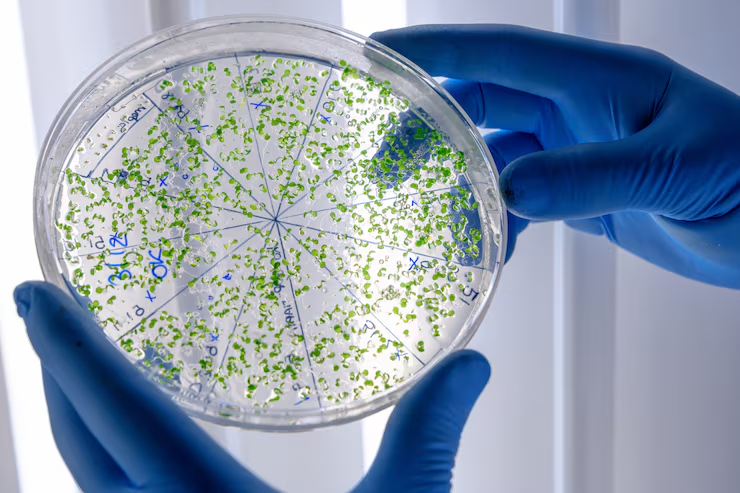
The invisible world of microorganisms plays a surprisingly pivotal role in how safely and efficiently modern facilities operate, regardless of industry. Healthcare institutions, food processing plants, commercial office buildings, and educational campuses all depend on understanding and managing the microbial populations that inevitably inhabit their spaces. As scientific knowledge advances and regulatory requirements tighten, facilities managers simply can’t afford to overlook these microscopic ecosystems living within their walls. What was once considered a specialized concern has transformed into a fundamental aspect of facility management.
The Growing Complexity of Indoor Microbial Environments
Modern facilities create uniquely complex environments where human activity, building systems, and environmental conditions converge to support surprisingly diverse microbial communities. Unlike outdoor environments where natural processes keep microbial populations in check, indoor spaces demand active management to prevent harmful organisms from taking hold. HVAC systems can inadvertently act as distribution networks, spreading microorganisms throughout entire buildings, while moisture accumulation in hidden corners and cavities creates perfect breeding grounds for fungi and bacteria. Today’s buildings pack more occupants into tighter spaces and operate around the clock, which only intensifies the microbial challenge.
Health and Safety Implications for Building Occupants
The health consequences of inadequate microbial awareness stretch far beyond the occasional illness outbreak and can seriously impact organizational productivity and legal liability. Pathogenic bacteria like Legionella lurking in cooling towers and water systems have triggered fatal outbreaks in hotels, hospitals, and commercial buildings that made national headlines. Mold growth stemming from water damage or persistent humidity issues can trigger allergic reactions, asthma attacks, and respiratory conditions that undermine employee performance and disrupt student learning. Healthcare, associated infections continue to challenge medical facilities, with antibiotic-resistant bacteria spreading through gaps in surface cleaning protocols and hand hygiene practices.
Regulatory Compliance and Legal Responsibilities
The regulatory landscape governing microbial control in facilities has expanded considerably in recent years, creating new compliance obligations that demand systematic awareness and meticulous documentation. Healthcare facilities must navigate stringent infection prevention standards established by accreditation bodies and government agencies, where violations can result in penalties, reduced payments, or even loss of licensure. Food industry facilities operate under comprehensive food safety regulations requiring hazard analysis, critical control points, and extensive microbial testing protocols. Commercial buildings in many jurisdictions must comply with indoor air quality standards and water system management requirements specifically designed to prevent Legionella and other waterborne pathogens.
Economic Benefits of Proactive Microbial Management
Investing in microbial awareness delivers substantial economic returns that extend well beyond simply avoiding the costs of outbreaks and compliance failures. Preventive microbial control invariably costs less than reactive crisis management, which often involves facility closures, emergency remediation, mounting legal expenses, and lasting reputational damage. Catching moisture problems and microbial growth early prevents the extensive structural damage that can necessitate costly repairs and major reconstruction projects. Cleaning protocols informed by microbial awareness actually reduce chemical usage and labor hours while improving outcomes through more targeted interventions.
Advanced Technologies Enabling Better Microbial Monitoring
Technological innovation has revolutionized the tools available for microbial awareness, enabling facilities to shift from periodic sampling to continuous monitoring and predictive analytics. Real, time air quality sensors can detect microbial indicators and environmental conditions conducive to growth, delivering instant alerts when intervention becomes necessary. Advanced molecular testing methods provide rapid identification of specific pathogens without the frustrating delays associated with traditional culture-based approaches. For professionals who need to test microbial contamination in diverse facility environments, Microbe Ninja provides comprehensive resources and protocols. Building automation systems now integrate humidity, temperature, and ventilation controls with microbial risk parameters, automatically adjusting conditions to prevent proliferation. Ultraviolet disinfection technologies have advanced to the point where they can provide continuous surface and air treatment even in occupied spaces, reducing pathogen transmission without leaving chemical residues. Artificial intelligence and machine learning algorithms analyze patterns from multiple data sources to predict high-risk conditions before visible contamination appears, essentially giving facilities a crystal ball for microbial threats. Mobile applications enable frontline staff to document cleaning activities, report moisture issues, and access microbial management protocols in real-time, right from their smartphones. These technological advances have made comprehensive microbial awareness more accessible and cost-effective for facilities of all sizes, democratizing capabilities that were once available only to the largest organizations with dedicated infection prevention departments.
Building a Culture of Microbial Awareness
Sustaining effective microbial management requires cultivating organizational awareness that extends beyond technical protocols to encompass values, behaviors, and shared responsibilities across all facility stakeholders. Leadership commitment establishes microbial awareness as a strategic priority rather than merely another maintenance function, allocating resources and attention proportionate to the actual risks involved. Comprehensive training programs ensure that employees at every level understand their specific role in microbial prevention, from reporting leaks promptly to following proper cleaning procedures consistently. Cross, functional collaboration between facilities management, environmental services, infection prevention, and occupational health creates coordinated approaches that address microbial challenges holistically rather than in isolated silos.
Conclusion
Microbial awareness has evolved from a specialized concern primarily relevant to healthcare facilities into an essential competency for managing any modern built environment effectively. The convergence of health imperatives, regulatory requirements, economic pressures, and technological capabilities makes comprehensive microbial management both more achievable and more critical than it’s ever been before. Facilities that embrace microbial awareness as a strategic priority position themselves to protect occupant health, maintain regulatory compliance, optimize operational efficiency, and build organizational resilience against emerging biological threats we can’t yet anticipate. The investment in systems, training, and culture required to establish robust microbial awareness programs delivers returns that ripple across every dimension of facility performance.